
By Venkateswara Rao | Published 2026-08-05 | 10 min read
The Human Randomness Paradox: Why We Build Predictable Passwords
Why the Human Brain Struggles with True Unpredictability
When asked to create a random password, human beings instinctively default to cognitive shortcuts. We pick familiar dates, pet names, favorite sports teams, or keyboard paths like qwerty or 1qaz2wsx. Even when we try to be clever by replacing an "a" with "@" or an "e" with "3", we are following predictable psychological substitution rules.
Attacking algorithms are engineered to mirror these exact human habits. Modern rule-based dictionary attacks take standard dictionary words and automatically test millions of character substitutions per second.
| Source | Example | Result |
|---|---|---|
| Human Mind | P@ssword123! | Follows predictable rules |
| Attacker Bot | Checks dictionary + rules instantly | Cracked in 0.0001 seconds |
| CSPRNG Engine | k9#mX2$vPL8!zQ1* | Zero patterns, max entropy |
| Attacker Bot | Brute-force attempt | Requires 300+ trillion years |
The Subconscious Keyboard Spatial Bias
Studies in cyber-psychology reveal that when typing on a physical QWERTY layout, people consistently favor keys located in the center rows or adjacent keys. This creates a spatial bias that drastically reduces the search space for brute-force tools.
What Is Cryptographic Randomness? (PRNG vs. CSPRNG)
The Technical Difference Between PRNG and CSPRNG
Not all computer-generated randomness is built equal. Standard programming algorithms use Pseudo-Random Number Generators (PRNGs), such as JavaScript's default Math.random(). While Math.random() works fine for simple web animations or dice rolls, it is completely unsafe for cryptographic security.
A standard PRNG uses a predictable seed value and mathematical formulas to create sequences that appear random. If an attacker observes a few outputs, they can reverse-engineer the internal state and predict every future number the system generates.
| Type | Mechanism | Output |
|---|---|---|
| Math.random() [PRNG] | Seed Value → Math Formula | Predictable |
| window.crypto [CSPRNG] | Hardware Noise → Cryptographic Hash | Pure Randomness |
Cryptographically Secure Pseudo-Random Number Generators (CSPRNG)
For generating secure credentials, systems must use a Cryptographically Secure Pseudo-Random Number Generator (CSPRNG). CSPRNGs fulfill two essential criteria:
- The Next-Bit Test: Given the first n bits of a sequence, no algorithm can predict the (n + 1)-th bit with a probability greater than 50%.
- State Compromise Extension: Even if an attacker learns the internal state of the generator, they cannot reconstruct past generated keys.
CSPRNGs harvest environmental entropy from physical hardware sources, such as CPU thermal noise, keystroke timing variations, and network interrupt patterns, ensuring true unpredictable output.
The Math of Digital Security: Understanding Password Entropy
Defining Cryptographic Entropy
In information theory, entropy measures the degree of randomness or uncertainty in a system. Coined by Claude Shannon in 1948, entropy is quantified in bits.
When applied to cybersecurity, entropy tells you how many binary guesses an attacker must make, on average, to crack a secret value. Higher entropy directly translates to greater resistance against brute-force attacks.
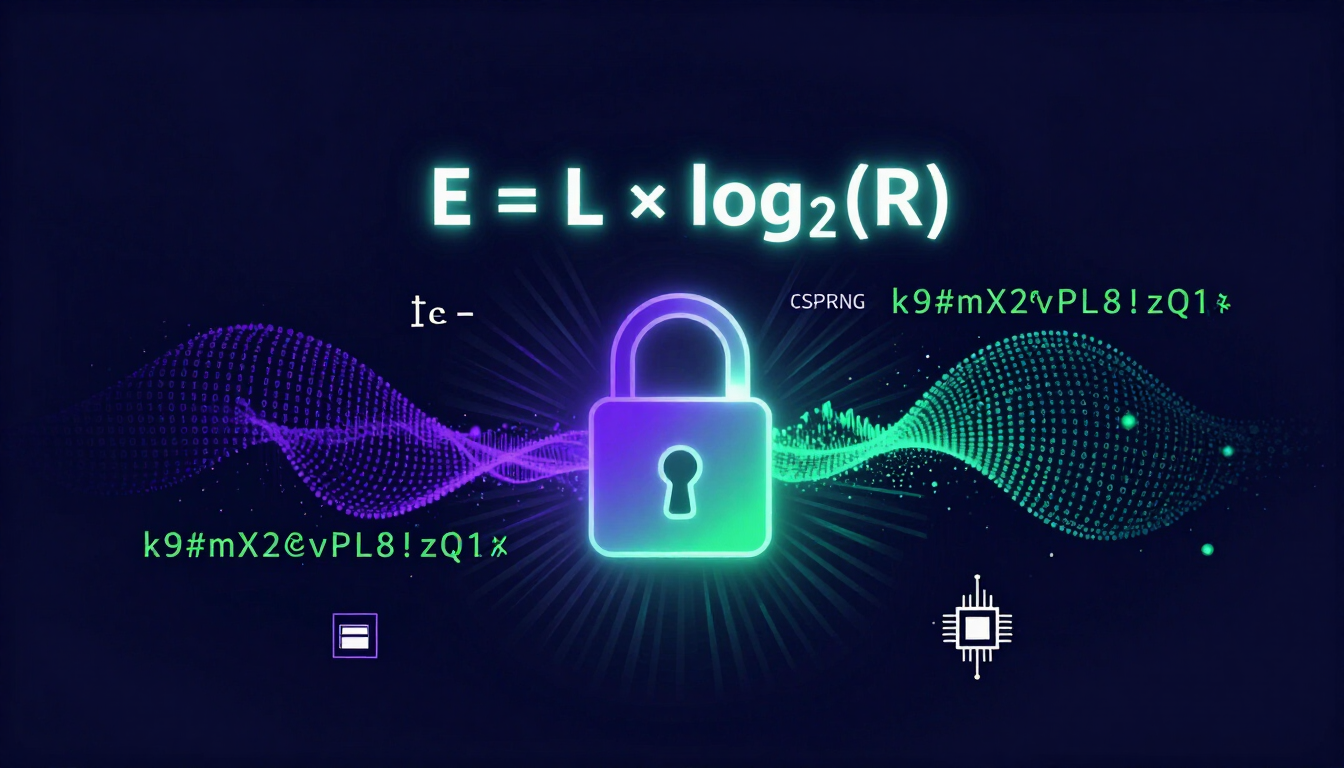
E = L × log2(R)Where:
• E = Password Entropy in Bits
• L = Password Length (Total Characters)
• R = Size of Character Pool (Available Symbols)
Breaking Down the Math Variables
Character Pool Size (R): The total count of unique possible characters allowed.
- Lowercase letters (a-z): 26
- Uppercase letters (A-Z): 26
- Numeric digits (0-9): 10
- Special symbols (!@#$%^&*...): 32
- Full Combined Pool (R): 26 + 26 + 10 + 32 = 94
Password Length (L): The total count of characters in the string.
Entropy Comparison Benchmark Table
| Password Example | Length (L) | Character Set Pool (R) | Calculated Entropy (E) | Security Level |
|---|---|---|---|---|
password | 8 | 26 (lowercase) | 37.6 Bits | Extremely Weak |
P@ssword1 | 9 | 94 (full set) | 59.0 Bits | Vulnerable |
k9#mX2$vPL8! | 12 | 94 (full set) | 78.7 Bits | Strong |
vX9#mK2$pL8!zQ1* | 16 | 94 (full set) | 104.9 Bits | Military-Grade |
Pro Tip: Increasing the length (L) increases security exponentially, whereas expanding the character pool (R) only increases it linearly. Length always beats complexity.
To learn more about long passphrases versus complex short passwords, review our detailed guide on Passphrase vs Password: Which Is Better for Security.
How Modern Browsers Compute a Random Password (window.crypto)
Client-Side vs. Server-Side Generation
When using a modern web utility like createpassword.in, your browser generates credentials locally inside your device's memory. This zero-knowledge approach ensures sensitive keys are never transmitted over network connections or stored in remote databases.
| Layer | What Happens | Security Outcome |
|---|---|---|
| User Device (Browser) | window.crypto.getRandomValues() executes | Generates uncrackable key in local RAM |
| Network / Cloud | NO network requests made | Zero server logs or leakage |
The Native JavaScript Implementation
Browsers achieve cryptographic randomness using the native window.crypto.getRandomValues() API. Here is a simplified technical illustration of how a client-side password generator random function computes entropy-rich strings:
function generateSecureRandomPassword(length = 16) {
  // Define character pool (R = 94)
  const charset =
    "ABCDEFGHIJKLMNOPQRSTUVWXYZabcdefghijklmnopqrstuvwxyz0123456789!@#$%^&*()_+-=[]{}|;:,<>?";
  const charsetLength = charset.length;

  // Allocate cryptographically secure typed array
  const randomValues = new Uint32Array(length);
  window.crypto.getRandomValues(randomValues);

  let password = "";
  for (let i = 0; i < length; i++) {
    // Modulo reduction over entropy array
    password += charset[randomValues[i] % charsetLength];
  }

  return password;
}
By leveraging window.crypto, web applications access OS-level entropy pools directly, delivering robust cryptographic security on demand.
For step-by-step developer documentation and implementation patterns, check out our Security Documentation & Tutorials.
Password Length vs. Character Pool Size: The Brute-Force Matrix
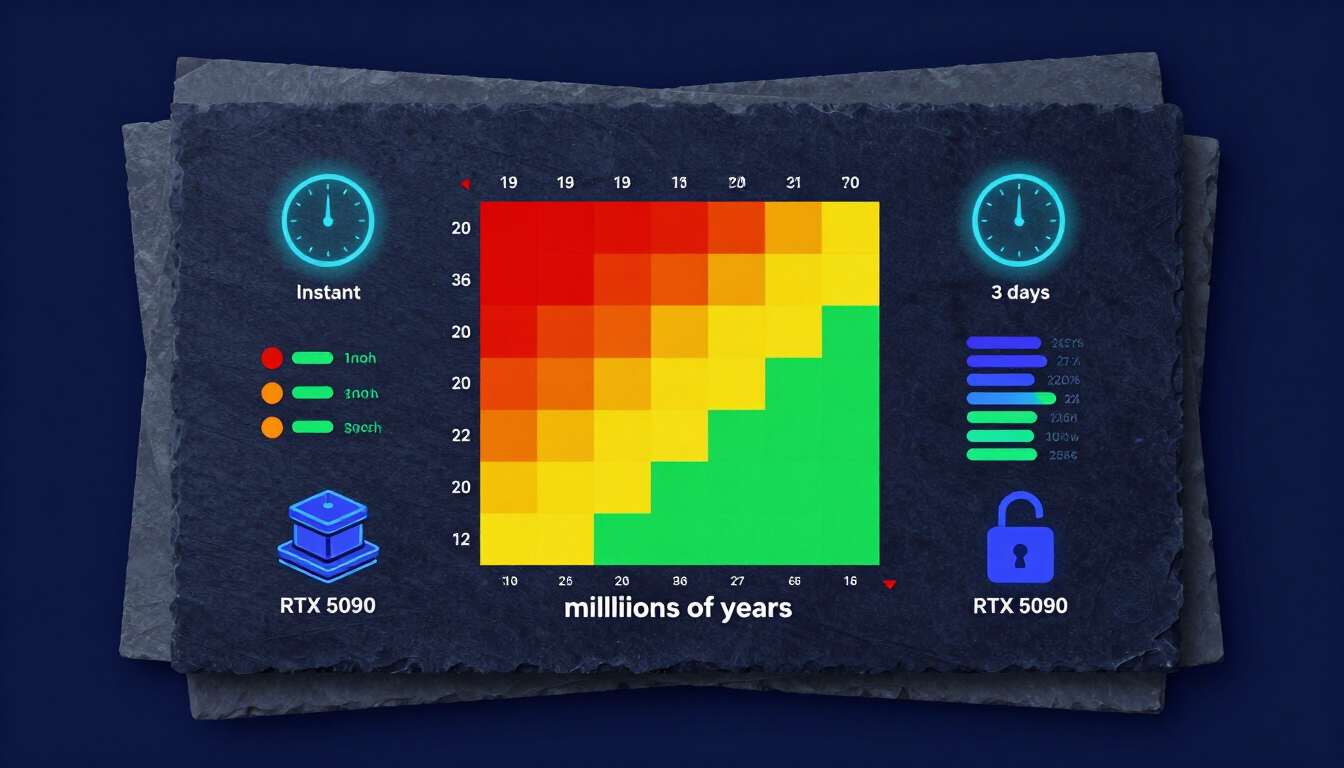
To understand how hardware advancements impact key safety, examine how cracking duration scales with character count when tested against a high-powered cracking rig performing 100 billion guesses per second (1011 guesses/sec).
Estimated Time-to-Crack Matrix
| Length | Numbers Only (R=10) | Lowercase (R=26) | Full Characters (R=94) |
|---|---|---|---|
| 8 Chars | Instant | Instant | ~ 1.5 Hours |
| 10 Chars | Instant | ~ 3 Mins | ~ 1.7 Years |
| 12 Chars | Instant | ~ 1.5 Days | ~ 15,000 Years |
| 16 Chars | ~ 1 Second | ~ 28,000 Years | ~ 3.5 trillion trillion Years |
Key Takeaways from the Matrix
- Short passwords are dead: Any string under 10 characters — even with symbols — is vulnerable to modern GPU acceleration.
- The 16-Character Sweet Spot: A 16-character string constructed from a full character pool yields over 100 bits of entropy, making it completely immune to brute-force attacks.
Explore our dedicated Passphrase Generator Tool to easily create long, readable, high-entropy secrets.
Common Myths About Password Randomness Busted
Myth 1: "Adding an @ symbol and a capital letter makes my password secure."
Fact: Rule-based cracking engines automatically append common symbols and capitalize the first letter of words. Substituting o with 0 or i with 1 provides zero effective resistance against automated dictionary attacks.
Myth 2: "A password generated on a website can be intercepted or saved."
Fact: True client-side tools execute entirely in your local browser memory using JavaScript. Inspecting the page network tab during generation reveals zero network requests, confirming total privacy.
Myth 3: "Passphrases are weaker because they use readable dictionary words."
Fact: Multi-word passphrases gain immense entropy through length (L). A 4-word passphrase selected randomly from a standard dictionary list yields over 77 bits of entropy, making it both exceptionally strong and easy to remember.
| Credential Type | Example | Characters | Entropy |
|---|---|---|---|
| Complex Short | x$9#mK2! | 8 Chars | ~52 Bits |
| Long Passphrase | correct horse battery staple | 28 Chars | ~77 Bits |
For an in-depth breakdown of these strategies, read our comparison guide on Passphrase vs Password.
How to Calculate and Test Your Password's True Randomness
Follow these simple steps to verify the cryptographic entropy of any string:
-
Count Character Pool Size (R)
- Lowercase only = 26
- Mixed Case Alphanumeric = 62
- Full Symbol Set = 94
- Measure Total Character Length (L) — Count every character in the string.
-
Apply the Binary Logarithm
- Entropy (E) = L × log2(R)
-
Evaluate the Score
- Below 50 Bits = Critical Risk
- 50–79 Bits = Moderate Security
- 80+ Bits = Military-Grade Defense
Alternatively, skip the manual calculations and test your credentials instantly using our comprehensive Password & Security Tools suite.
Practical Step-by-Step Blueprint for Maximum Security
To lock down your digital life against credential stuffing, data breaches, and brute-force tools, adopt this 4-step framework:
-
Generate 16+ Character Strings using CSPRNG Tools
Use client-side tools like createpassword.in -
Never Reuse Credentials Across Different Sites
Ensure every online service uses a unique random string. -
Store Secrets in a Secure Password Manager
Use zero-knowledge vaults to manage complex credentials. -
Enable Multi-Factor Authentication (MFA)
Add a hardware key or authenticator app as a second layer.
For a complete walkthrough on configuring defensive controls across your accounts, read our Complete Guide to Creating Strong Passwords in 2026.
Key Takeaways
- Human randomness is a myth: The human brain naturally relies on predictable patterns, making manually created passwords vulnerable to rule-based dictionary attacks.
- CSPRNGs are mandatory: Secure generation requires OS-level entropy harvested via
window.crypto.getRandomValues()rather than predictable functions likeMath.random(). - Length beats complexity: Extending password length (L) increases entropy exponentially, while adding character sets (R) increases it linearly.
- Aim for 80+ bits of entropy: Use 16-character randomized passwords or 4-word passphrases to ensure your credentials remain uncrackable.
Conclusion
True digital security relies on mathematical entropy rather than memorable patterns. By transitioning from human-made passwords to cryptographically generated, high-entropy keys, you eliminate common attack vectors and safeguard your digital presence.
With these principles in place, you are ready to secure your accounts against modern automated threats.
Ready to build uncrackable credentials? Generate a high-entropy, cryptographically secure password instantly with our Free Password Generator Tool.
Author Profile (E-E-A-T)
Venkateswara Rao
I built CreatePassword.in to offer free browser-based password tools and practical security guides. createpassword.in Security Hub.

Leave a comment
Comments are moderated before appearing. Please keep it respectful and on-topic. Your email is required for verification but is never displayed publicly or shared.