
Opening Hook
It takes a modern threat actor approximately 4 seconds to crack a 12-character password containing only lowercase letters. However, a complex 12-character password utilizing uppercase letters, lowercase letters, numbers, and symbols takes approximately 226 years to crack via brute force.
The timeline for compromising credentials has collapsed. Hardware acceleration, optimized cracking algorithms, and the sheer volume of breached data have rendered legacy password guidelines obsolete. A 12-character baseline is no longer an impenetrable fortress; it is the absolute bare minimum required to force an attacker to expend meaningful computational resources.
This comprehensive guide dissects the exact timeframes, computational mechanics, and mathematical entropy behind the brute force 12 character password time. Put the principles into practice immediately with our password generator or the free password generator tool, and explore hands-on walkthroughs in our Security Documentation & Tutorials.
The 2026 Password Cracking Matrix
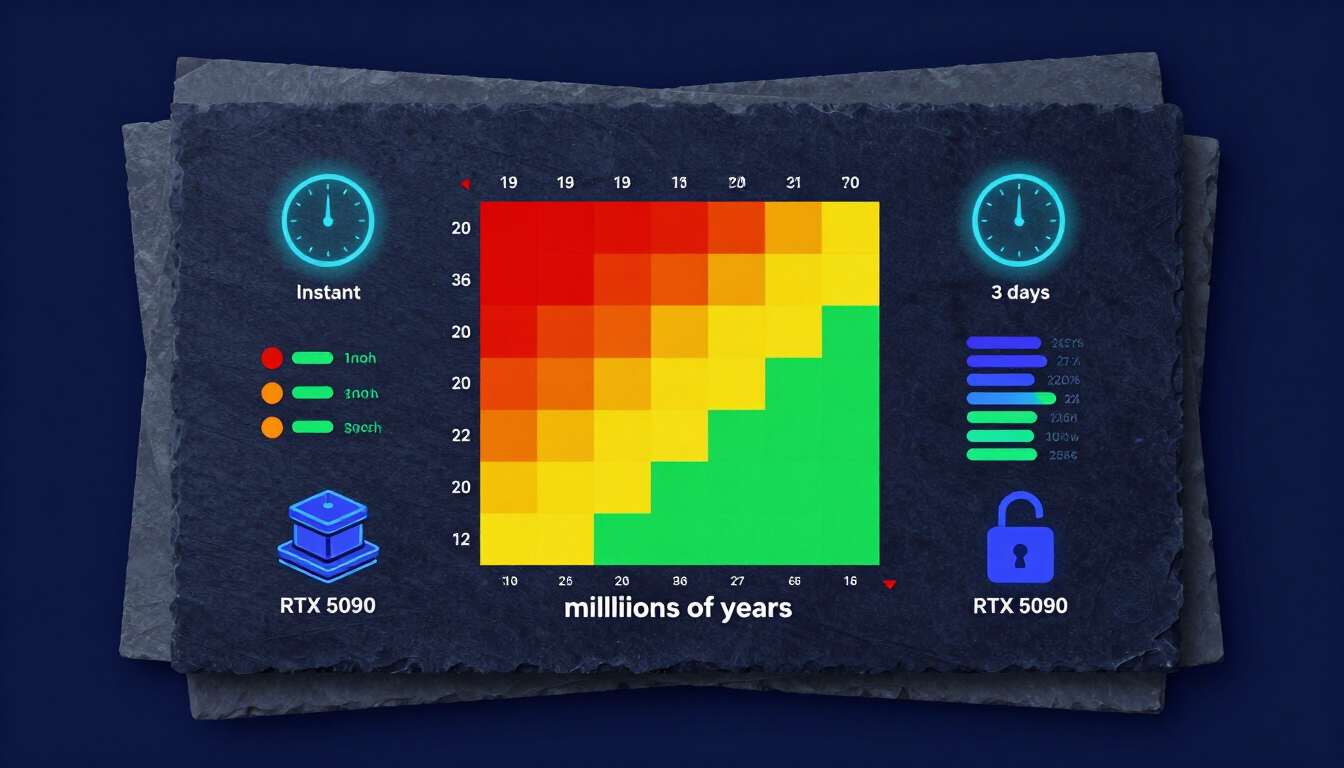
Understanding the true vulnerability of a credential requires analyzing the intersection of length and the character pool. The data below reflects the computational capabilities available to well-funded threat actors and penetration testers in 2026, utilizing parallel GPU processing clusters.
This updated matrix aligns with the methodologies used to generate the Hive Systems password table 2026, providing a clear visual representation of risk.
2026 Password Cracking Matrix
| Character Pool (Complexity) | 8 Characters | 10 Characters | 12 Characters | 16 Characters |
|---|---|---|---|---|
| Numbers Only (0-9) | Instant | Instant | 2 seconds | 14 hours |
| Lowercase Letters (a-z) | Instant | Instant | 4 seconds | 12 years |
| Upper & Lowercase (A-z) | Instant | 5 seconds | 14 minutes | 1.5 million years |
| Alphanumeric (A-z, 0-9) | Instant | 22 seconds | 3 days | 3 billion years |
| Complex (Includes Symbols) | 4 minutes | 1 month | 226 years | 2 trillion years |
Alt Text: "Comprehensive 2026 password cracking matrix detailing the brute force 12 character password time across multiple complexity tiers."
Analyzing the Matrix Vulnerabilities
Three critical vulnerabilities emerge from this data:
- The Illusion of Length: A 16-character password made entirely of numbers can be cracked in under 14 hours. Length without complexity is a mathematically flawed defense.
- The 12-Character Threshold: Notice the massive jump in security at the 12-character mark when symbols are introduced. The jump from 3 days (Alphanumeric) to 226 years (Complex) demonstrates why mandatory symbol requirements exist in enterprise environments.
- The "Instant" Danger Zone: Any password under 10 characters lacking symbols is essentially plain text to modern hashing rigs. The software does not even need to "guess"; the hashes are pre-computed or processed faster than the human eye can register the terminal output.
Generate a complex, high-entropy credential now with our password generator or free password tool to ensure you stay out of the danger zone.
The Hardware Arms Race: RTX 5090 and Hashcat
The rapid reduction in the time to crack 12 character password hashes stems directly from consumer hardware capabilities. We are no longer discussing theoretical supercomputers; we are discussing off-the-shelf gaming hardware.
GPU Password Cracking Speed Explored
Historically, password cracking relied on the Central Processing Unit (CPU). CPUs are designed for rapid, sequential task execution. However, brute-forcing a cryptographic hash requires parallel processing—executing the same simple mathematical operation millions of times simultaneously.
Graphics Processing Units (GPUs) contain thousands of smaller, highly efficient cores designed precisely for this type of parallel workload.
Three key factors drive modern password cracking speed:
- The RTX 5090 Baseline: A single NVIDIA RTX 5090 graphics card can process tens of billions of standard hashes (like MD5 or NTLM) per second.
- Clustered Rigs: Threat actors rarely use a single GPU. Specialized cracking rigs string together 4, 8, or even 16 GPUs on custom motherboards.
- Cloud Computing: Attackers rent massive GPU clusters via cloud computing providers (AWS, Azure) using stolen credit cards, spinning up thousands of virtual machines to execute a distributed brute-force attack in minutes.
Under the Hood: The Code Powering the Attack
To understand the sheer speed of these attacks, one must look at the underlying software engineering. Elite cracking tools like Hashcat are not written in high-overhead languages like Python; they are built in low-level C programming to interact as closely with the hardware as possible.
When a password cracker initializes an attack against a leaked database, memory optimization is paramount. The software relies heavily on dynamic memory allocation. By utilizing malloc() and scaling with realloc(), the program can load massive, multi-gigabyte dictionary files directly into the system's RAM without crashing.
Once the data is in memory, the speed relies on strict array manipulation and pointer arithmetic. C pointers allow the CPU and GPU to iterate through potential password hashes in microscopic fractions of a second, bypassing the overhead of standard variable reassignment.
Furthermore, the initial parsing of breached databases—often text files containing billions of lines—relies on highly optimized file input/output functions. The software rapidly iterates through text using fgetc() for character-by-character analysis or reads formatted string structures via fscanf(). To move these massive datasets between the CPU and the GPU memory banks, functions like memcpy() execute high-speed block transfers.
This combination of brute hardware force and flawlessly optimized C programming is exactly why a poorly constructed 12-character password stands no chance.
The Mathematics of Defense: Calculating Password Entropy
To understand why complexity matters as much as length, cybersecurity professionals use a mathematical concept called Entropy. Entropy measures the unpredictability of a string of characters and is expressed in "bits."
The higher the bit count, the more difficult the password is to guess. The formula for calculating password entropy is:
Where:
- E = Total Entropy in bits
- L = Length of the password
- R = Size of the character pool
Character Pool (R) Values Breakdown
- Numeric Only (0-9): 10
- Lowercase Only (a-z): 26
- Upper & Lowercase (A-z): 52
- Alphanumeric (A-z, 0-9): 62
- Complex (Upper, Lower, Numbers, Symbols): 95
Entropy Examples in Action
Let us apply this formula to the primary keyword focus: the 12-character password.
Scenario A: 12 Characters, Lowercase Only
- L = 12
- R = 26
- E = 12 × log₂(26)
- Result: ~56.4 bits of entropy.
- Verdict: Extremely weak. A modern GPU rig will chew through 56 bits of entropy in a matter of seconds.
Scenario B: 12 Characters, Complex Character Pool
- L = 12
- R = 95
- E = 12 × log₂(95)
- Result: ~78.8 bits of entropy.
- Verdict: Highly secure. The exponential nature of base-2 logarithms means that jumping from 56 to 78 bits doesn't just double the cracking time; it multiplies it by millions, pushing the brute-force time out to 226 years.
As a general security guideline, any password protecting sensitive personal or financial data should possess a minimum of 75 bits of entropy. Use our password generator or free password tool to create credentials that meet this threshold, and learn more in our complete guide to creating strong passwords in 2026.
Beyond Brute Force: Modern Attack Vectors
Relying strictly on the "time to crack" metrics assumes the attacker is utilizing a blind brute-force method—guessing every single possible combination from aaaa to zzzz. In reality, modern attackers are much more efficient. They utilize targeted methodologies that drastically reduce the time to crack 12 character password hashes.
1. Dictionary Attacks
Attackers rarely start by guessing random letters. They start with dictionaries. These are not just standard English dictionaries; they are massive compilations of every word, slang term, pop culture reference, and previously breached password ever recorded on the internet. If your 12-character password is "batteryhorse" (two dictionary words), a brute force calculation might say it takes centuries, but a dictionary attack will crack it in milliseconds.
2. Rule-Based Attacks
Humans are predictable. When forced to meet a 12-character requirement with a capital letter and a number, 90% of users will capitalize the first letter and put a "1" or "123" at the end (e.g., Summer2026!).
Rule-based attacks take a standard dictionary file and apply rules to it. The software automatically appends dates, capitalizes specific letters, and swaps vowels for numbers (e.g., turning password into P@ssw0rd123). This renders basic substitutions completely ineffective.
3. Credential Stuffing
This attack doesn't bother cracking your hash at all. Threat actors purchase databases of compromised credentials from the dark web (resulting from breaches at major companies). They then use automated botnets to test those exact email and password combinations across thousands of other websites, banking portals, and corporate VPNs.
If you use the same highly complex, 78-bit entropy password for both a poorly secured forum and your primary email account, the strength of the password is irrelevant once the forum is breached.
4. Rainbow Tables
A rainbow table is a massive, pre-computed database of cryptographic hashes. Instead of calculating the hash for "Password123!" on the fly, the attacker simply looks up the hash in their database to see what plain-text password corresponds to it. While the implementation of "salting" (adding random data to the hash) mitigates rainbow tables, poorly configured legacy systems remain highly vulnerable to this high-speed lookup method.
The Psychological Flaws in Password Creation
The greatest vulnerability in any cryptographic system is the human operating it. When forced to create long, complex strings of text, human psychology defaults to patterns, rendering the mathematical protections of a 12-character password void.
- Keyboard Walking: Sequences like
QWERTYuiop12orasdfghjkl;meet length and complexity requirements but contain zero true entropy. Cracking software is explicitly programmed to test keyboard patterns first. - Personal Identifiers: Incorporating birth years, pet names, favorite sports teams, or local zip codes. This information is readily available via Open Source Intelligence (OSINT) gathering on social media platforms. Attackers compile custom dictionaries based on a target's LinkedIn or Facebook profile before launching an attack.
- Predictable Anchors: The human brain struggles to memorize random symbol placement. Therefore, users almost universally place symbols at the very end of the string. A password like
Tr0ub4dor&3is infinitely harder to crack thanTroubador3&simply due to the internal placement of the numerical and symbolic anchors.
Eliminate human bias by using a cryptographic password generator or free password tool, and store credentials safely as described in our guide to using a password generator free of charge.
Password Strength Guidelines for 2026 and Beyond
Systems administrators, IT professionals, and security-conscious internet users must implement robust policies that acknowledge the realities of the 2026 password cracking matrix.
1. Shift from Passwords to Passphrases
The National Institute of Standards and Technology (NIST) guidelines increasingly emphasize length over forced complexity. A passphrase consists of multiple, unrelated random words.
- Traditional Complex Password:
k9#Pq2$vL!x(Hard to remember, easy to mistype, 11 characters). - Modern Passphrase:
coffee-stapler-mountain-ocean(Easy to remember, 29 characters).
Even utilizing only lowercase letters and hyphens, a 29-character passphrase offers so much mathematical entropy that it completely breaks modern GPU cracking capabilities, pushing the brute-force timeline into billions of years. Generate one instantly with our passphrase generator.
2. Implement Mandatory Length Minimums
Corporate active directory environments and user-facing applications must enforce a strict baseline.
- Standard Accounts: 12-character minimum.
- Privileged / Admin Accounts: 16-character minimum.
3. Eliminate Arbitrary Expiration Dates
NIST officially recommends dropping the practice of forcing users to change their passwords every 30, 60, or 90 days. Data proves that forced expiration leads to password fatigue. Users simply iterate their current password (Welcome2026! becomes Welcome2026@).
Organizations should only force a password reset if there is evidence of a localized breach or suspected compromise.
4. Utilize Password Managers
It is fundamentally impossible for a human being to memorize 50 unique, 16-character, high-entropy passwords. Password managers generate, encrypt, and store credentials locally or in a secure cloud vault. The user only needs to remember a single, exceptionally strong Master Passphrase. This completely eliminates the threat of credential stuffing attacks, as every single account utilizes a distinct, random string. Generate unique credentials with our password generator or free password tool.
5. Multi-Factor Authentication (MFA) is Non-Negotiable
No password policy is complete without Multi-Factor Authentication acting as a secondary defense layer. If an attacker successfully bypasses the brute force 12 character password time and recovers the plain-text credential, MFA halts the intrusion.
- SMS Based MFA: Better than nothing, but vulnerable to SIM-swapping attacks.
- Authenticator Apps (TOTP): Generates a time-based token on the user's mobile device (e.g., Google Authenticator, Authy). Highly recommended.
- Hardware Security Keys: Physical USB or NFC devices (e.g., YubiKey) that must be inserted into the machine. This is the gold standard, effectively neutralizing phishing and remote credential compromise.
The Future Threat: Quantum Computing vs. Passwords
While the RTX 5090 Hashcat benchmarks define the current threat landscape, cybersecurity strategists must look ahead to the post-quantum era.
Quantum computers operate on qubits, allowing them to process multiple states simultaneously. Shor's Algorithm, a theoretical quantum algorithm, is capable of factoring massive prime numbers exponentially faster than classical computers. While primarily a threat to asymmetric encryption (like RSA), quantum computing will eventually impact hashing algorithms.
Grover's Algorithm, another quantum concept, can theoretically reduce the time required for a brute-force attack on a hash function to its square root.
If a classical computer needs 2128 operations to break a hash, a quantum computer running Grover's algorithm would only need 264 operations.
While stable, cryptographically relevant quantum computers are likely a decade away, the data you secure today with a 12-character password may be harvested now and decrypted later in a "Store Now, Decrypt Later" (SNDL) attack. Future-proofing requires transitioning to 16+ character passphrases immediately to maintain security margins against impending quantum advancements.
Frequently Asked Questions
1. Is 12 characters a strong password in 2026?
A 12-character password is only considered strong if it utilizes a highly complex character pool consisting of uppercase letters, lowercase letters, numbers, and symbols. If it relies on a single dictionary word, sequential numbers, or solely lowercase letters, it possesses low entropy and can be cracked in minutes by modern GPUs.
2. How long does it take to crack a 16-character password?
Using a complex character pool, a 16-character password would take a modern GPU cluster approximately 2 trillion years to crack via pure brute force. However, if the 16 characters consist only of numbers, it can be cracked in less than 14 hours.
3. Why is Hashcat so fast?
Hashcat is an advanced password recovery tool written in C. It leverages the parallel processing architecture of modern graphics cards (GPUs) to compute billions of hashes simultaneously. It also utilizes optimized memory management and array handling to feed target hashes to the GPU cores without computational bottlenecking.
4. Should I use a password generator?
Yes. Human psychology makes us inherently bad at creating truly random strings of text. A cryptographic password generator removes human bias, ensuring maximum entropy. You should use a trusted generator to secure high-value accounts, and store those credentials in an encrypted password manager. Try our password generator or free password tool now.
5. Does changing my password frequently improve security?
No, it often degrades security. Frequent, forced password resets lead to "password fatigue." Users tend to create weaker passwords or make predictable minor adjustments to their old passwords to cope with the changing requirements. You should focus on creating a high-entropy, unique 12+ character password and only change it if you suspect the platform has suffered a data breach.
6. What is the Hive Systems Password Table?
The Hive Systems table is an annually updated, industry-recognized graphic that illustrates the time required for hackers to crack passwords of various lengths and complexities. It serves as a visual benchmark for IT professionals to demonstrate the critical importance of password complexity to end-users.
Author Profile (E-E-A-T)
Venkateswara Rao
Founder of CreatePassword.in. I build free, browser-based password tools and practical security guides. Learn more on the tutorials hub.
External Security References
- Hive Systems Password Table 2026
- NIST SP 800-63B Digital Identity Guidelines
- Hashcat Documentation
- NVIDIA RTX 5090 Specifications
Related Resources:
- Password Generator — createpassword.in
- Security Documentation & Tutorials
- Password Generator Tool
- Password Generator
- Password & Security Tools
- Passphrase Generator
- The Ultimate Guide to Using a Password Generator Free
- Complete Guide to Creating Strong Passwords in 2026
- 12 Character Password Generator: Free, Secure & Instant Tool
- Passphrase vs Password
- Passphrase vs Password: Which Is Better for Security


Leave a comment
Comments are moderated before appearing. Please keep it respectful and on-topic. Your email is required for verification but is never displayed publicly or shared.