
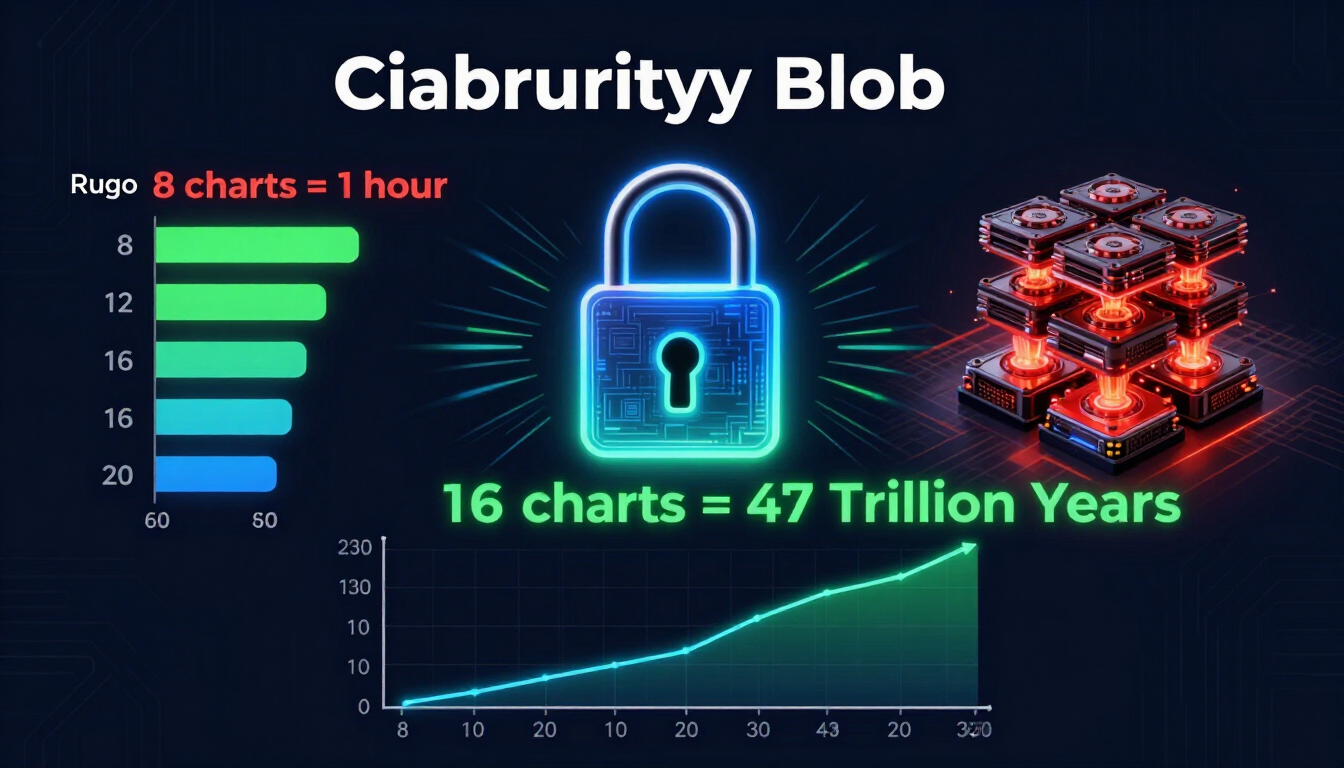
The Mathematical Reality of Brute-Force Attacks
When non-technical users attempt to secure their accounts, they often overestimate the strength of their passwords. Phrases like P@ssw0rd1! feel complex to a human memory, but to an automated brute-force cracking framework running Hashcat or John the Ripper, they represent low-hanging fruit.
Human Perception: "P@ssw0rd1! is complex because it has symbols."
Attacker Reality: Rule-based dictionary attack cracks it in < 1ms.
Mathematical Truth: Randomness + Length = Unbreakable Search Space.
An automated attack does not "think" or "guess" like a human. It iterates sequentially or probabilistically through every combination in a theoretical search space.
To determine how long to crack password strings, security researchers calculate two variables:
- The total size of the keyspace (S): The total number of possible unique character combinations.
- The attacker's hashing rate (H): The number of cryptographic hashes the attacker's hardware can calculate per second.
Crack Time (Seconds) = Total Keyspace Size (S) ÷ Hashes Per Second (H)
When you utilize a modern strong password generator, you expand the total keyspace S to a number so vast that even computing power bounded by the laws of physics cannot cycle through it within a human lifetime.
The Physics of Password Entropy (E = L × log₂(N))
In cryptographic engineering, password strength is not measured by subjective complexity or arbitrary rating meters. It is quantified in bits of entropy. Entropy measures the randomness and unpredictability in a secret string.
The Entropy Equation
To calculate the total bit entropy (E) of a randomly generated string, use the standard Shannon Entropy formula for uniform character distributions:
E = L × log₂(N)
Where:
- L = Length of the password (number of characters).
- N = Size of the character pool (number of possible unique symbols available per slot).
| Character Set | Pool Size (N) |
|---|---|
| Numbers Only (0–9) | N = 10 |
| Lowercase Letters Only (a–z) | N = 26 |
| Mixed-Case Letters (a–z, A–Z) | N = 52 |
| Alphanumeric (a–z, A–Z, 0–9) | N = 62 |
| Full ASCII Symbols (a–z, A–Z, 0–9, Symbols) | N = 94 |
Entropy Scale & Cryptographic Safety Thresholds
- 0 to 40 Bits (Critical Threat): Vulnerable to instant automated cracking within seconds across basic consumer hardware.
- 41 to 64 Bits (Weak): Susceptible to targeted offline hash cracking on modest GPU rigs within hours or days.
- 65 to 80 Bits (Moderate): Resistant to basic attacks, but vulnerable to dedicated multi-GPU cracking clusters over extended periods.
- 81 to 128+ Bits (Ultra-Secure): Mathematically uncrackable under current and near-future computing capabilities. Ideal for financial, corporate, and infrastructure security.
Using a 16 character password generator with full ASCII symbols (N = 94) yields:
E = 16 × log₂(94) ≈ 16 × 6.55458 = 104.87 Bits of Entropy
A search space of 2104.87 options renders conventional brute-force cracking completely ineffective.
Comprehensive Brute-Force Crack Time Matrix (8 vs 12 vs 16 vs 20 Characters)
To illustrate the stark differences in resistance between lengths, examine the time required to complete an exhaustive search across various lengths and character set configurations.
Benchmark Hardware Profile
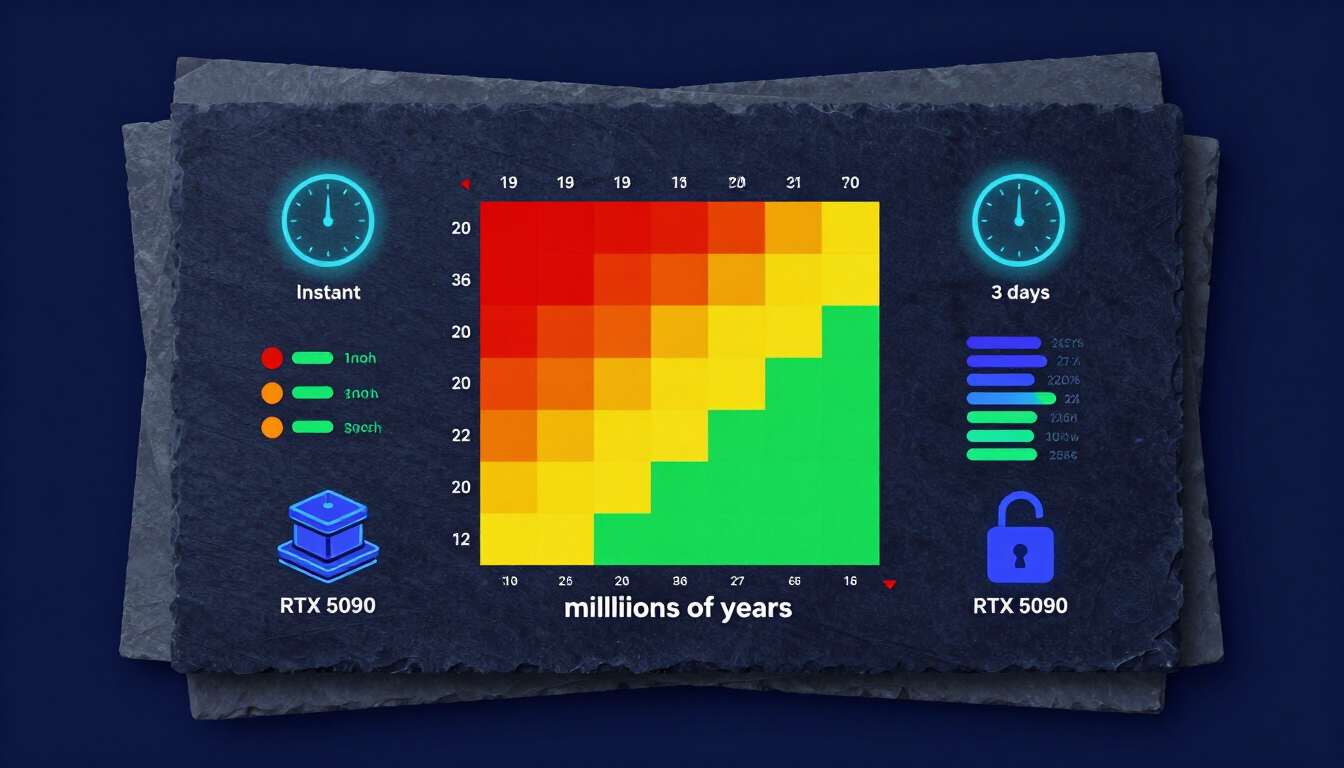
The calculations below assume an offline scenario where an attacker has extracted an unsalted MD5/SHA-1 password hash dump and is using a modest modern cracking rig capable of testing 100 Billion (1011) hashes per second (equivalent to an enterprise cluster of 8x NVIDIA RTX 4090 GPUs running Hashcat).
| Character Length | Numbers Only (N = 10) | Lowercase Letters (N = 26) | Alphanumeric (N = 62) | Full ASCII Symbols (N = 94) |
|---|---|---|---|---|
| 8 Chars | 0.000001 Sec | 0.002 Sec | 2.18 Minutes | 60.95 Minutes |
| 10 Chars | 0.0001 Sec | 1.41 Minutes | 9.68 Days | 1.89 Years |
| 12 Chars | 0.01 Sec | 15.98 Hours | 3,241 Years | 608,848 Years |
| 14 Chars | 1.00 Sec | 71.1 Days | 12.46 Million Yrs | 5.38 Billion Years |
| 16 Chars | 1.66 Minutes | 356.1 Years | 47.88 Billion Yrs | 47.63 Trillion Years |
| 18 Chars | 2.77 Hours | 240,768 Years | 184 Trillion Yrs | 421.2 Quadrillion Years |
| 20 Chars | 11.57 Days | 162.9 Million Yrs | 707 Quadrillion Yrs | 3.72 Quintillion Years |
Logarithmic Expanding Crack Time — time to crack increases exponentially with length:
- 8 Chars: < 1 Hour
- 12 Chars: Hundreds of Thousands of Years
- 16 Chars: Trillions of Years
- 20 Chars: Quintillions of Years
Length vs. Complexity: Why Exponential Math Wins Every Time
One of the most persistent cybersecurity myths is that adding a few special characters (like !, @, #) to a short password makes it unbreakable. Mathematically, this is incorrect.
The Linear vs. Exponential Trap
- Adding Character Sets (Increasing N): Increases entropy linearly.
- Adding Character Length (Increasing L): Increases entropy exponentially.
| Scenario | Configuration | Combinations | Crack Time @ 100B/sec |
|---|---|---|---|
| Scenario A | 8 Characters, Full Symbols (N=94) | 948 = 6,095,689,385,410,816 | ~60.9 Minutes |
| Scenario B | 16 Characters, Lowercase Only (N=26) | 2616 = 43,608,742,899,428,878,847,025,152 | ~356 Years |
Even though Scenario B uses only lowercase letters, its search space is 7 million times larger than Scenario A.
When you use a 16 character password generator and enable symbols alongside numbers and letters, you combine both exponential length and maximum pool depth, rendering the secret uncrackable.
Hardware Evolution Benchmark: Consumer GPUs to Nation-State Hash Arrays
To understand how security parameters change over time, we must track the hardware capabilities of modern cracking setups.
| Level | Hardware | MD5 Hashes/Sec |
|---|---|---|
| Level 1 | Consumer Laptop CPU (Core i7) | ~50 Million |
| Level 2 | Desktop Gaming GPU (Single RTX 4090) | ~15 Billion |
| Level 3 | Custom Cracking Rig (8x RTX 4090 Array) | ~120 Billion |
| Level 4 | Nation-State / Data-Center Cluster (1,000 GPUs) | ~15 Trillion |
The Impact of Moore's Law and Parallel Computing
As graphics processors add more CUDA cores and specialized AI hardware, parallel execution power rises:
- 1998 (EFF DES Cracker): 56 Billion Keys / Sec
- 2012 (25-GPU Hashcat Cluster): 350 Billion Hashes / Sec
- 2026 (Modern GPU Rig Array): 15+ Trillion Hashes / Sec
Because hardware performance continues to advance, standard lengths that were considered safe ten years ago (such as 8 or 10 characters) are now completely obsolete. Modern security standards mandate a minimum of 12 to 16 characters for all accounts.
Offline Hash Cracking vs. Online Rate-Limited Guessing
When asking how long to crack password combinations, it is vital to distinguish between online attacks and offline attacks.
| Attack Type | Vector | Speed | Threat Level |
|---|---|---|---|
| Online Brute-Force | Web Form / API Endpoint — throttled by WAF, rate-limited to 3–5 attempts before lockout | ~1 to 10 guesses/sec | Low for unique passwords |
| Offline Hash-Cracking | Stolen Leaked Hash Database — local processing, zero rate limits or lockouts | Billions to trillions/sec | Extremely High for short/weak passwords |
Attack Vector Comparison for an 8-character password:
- Online Rate-Limited Attack (5 Req/Min): ~380 Years to crack
- Offline Hash Extraction (Local GPU Array @ 100B/Sec): ~2.18 Minutes to crack
Because enterprise database leaks happen frequently across the web, you must always choose password lengths that withstand offline high-speed hash cracking.
Targeted Character Presets for Banking, Email, Wi-Fi, and Critical Infrastructure
Different online services carry different threat profiles. Below are the security presets recommended by cryptography research team at createpassword.in:
-
[CRITICAL] Financial & Online Banking
Length: 20+ Characters | Pool: Uppercase + Lowercase + Numbers + Full Symbols | Entropy: ~131 Bits
Strategy: Generate using a strong password generator, store in vault. -
[HIGH] Primary Email & Master Password Vaults
Length: 16 to 20 Characters (or 4–5 Word Passphrases) | Pool: Uppercase + Lowercase + Numbers + Symbols | Entropy: ~105–131 Bits
Strategy: Memorizable high-entropy passphrases or hardware keys. -
[MEDIUM] Wi-Fi Networks (WPA2 / WPA3)
Length: 18 to 24 Characters | Pool: Alphanumeric + Select Symbols (avoid spaces for compatibility) | Entropy: ~110 Bits
Strategy: Prevents offline capture & crack dictionary attacks. -
[STANDARD] Social Media, Forums & Streaming
Length: 14 to 16 Characters | Pool: Uppercase + Lowercase + Numbers | Entropy: ~83–95 Bits
Strategy: Unique credential per platform to prevent credential stuffing.
| Target Application | Recommended Length | Recommended Pool | Target Bit Entropy | Primary Threat Mitigated |
|---|---|---|---|---|
| Online Banking & Investments | 20+ Chars | Full ASCII (N = 94) | ~131 Bits | Offline DB leaks, credential stuffing |
| Primary Email Account | 16–20 Chars | Full ASCII (N = 94) | ~105 Bits | Password reset hijack chain |
| Master Password (Vault) | 20+ Chars | Full ASCII / Passphrase | ~131 Bits | Targeted offline vault cracking |
| Wi-Fi Router (WPA2/WPA3) | 18–24 Chars | Alphanumeric (N = 62) | ~107 Bits | Offline PMKID / handshake capture |
| Social Media & Gaming | 14–16 Chars | Alphanumeric (N = 62) | ~83 Bits | Automated stuffing botnets |
Generate target-specific credentials instantly on our dedicated Passphrase Generator Tool.
The Role of Key Derivation Functions (KDFs): Argon2, bcrypt, and PBKDF2
Length is your primary line of defense, but server-side cryptographic architecture also plays a role in slowing down brute-force attacks. Modern platforms use Key Derivation Functions (KDFs) to artificially slow hash calculations.
| Algorithm Type | Speed per GPU |
|---|---|
| Fast Hash (MD5 / SHA-256) | ~100,000,000,000 hashes/sec |
| Slow KDF (Argon2id / bcrypt) | ~10,000 to 50,000 hashes/sec |
Hash Processing Delay Comparison:
- Fast Hash (SHA-256): [ Input Password ] → [ Fast Compute ] → [ Hash Output ] — 0.000001 ms
- Slow KDF (Argon2id): [ Input Password ] → [ Memory Hard Work ] → [ Hash Output ] — 100 ms Artificial Delay
By introducing artificial memory and CPU costs, modern algorithms like Argon2id make offline brute-force attacks radically more expensive for attackers.
However, because end users cannot control how third-party websites hash their passwords internally, relying on a strong password generator to create 16+ character secrets remains your best personal defense.
How to Deploy a 16+ Character Security Framework for Free
Implementing strict credential security across dozens of online services does not require spending money or memorizing dozens of complex strings.
-
Generate High-Entropy Secrets
Use createpassword.in to generate 16 to 20 character strings using local browser CSPRNG math. -
Store in Zero-Knowledge Vaults
Save credentials in secure open-source managers (Bitwarden, KeePass) or native OS keychains (Apple Keychain, Google Password Manager). -
Enforce Multi-Factor Authentication (MFA)
Enable hardware keys (YubiKey) or TOTP authenticator apps.
For step-by-step instructions on implementing this architecture across all your devices, check out our Complete Guide to Creating Strong Passwords in 2026.
Key Takeaways
- Length dominates complexity: Adding characters grows the search space exponentially (NL), whereas adding character sets only grows it linearly.
- 8 characters is obsolete: Short passwords can be cracked in minutes on modern GPU hardware regardless of symbol complexity.
- 16 characters is the modern gold standard: A randomly generated 16-character credential provides over 104 bits of entropy, protecting you against offline attacks.
- Protect against offline leaks: You cannot control how websites store your hashes, but using length ensures your credentials survive offline data breaches.
Conclusion
The math behind brute-force cracking is clear: length is the single most effective defense against automated attacks. Moving from short, complex strings to randomly generated 16+ character secrets expands your security perimeter beyond the reach of modern GPU clusters.
By utilizing client-side tools and reliable password storage, you can protect all your digital accounts with zero friction.
Need to generate uncrackable, 100% free credentials right now? Try our zero-knowledge Free Password Generator Tool — no registration, software downloads, or fees required.
About the Author
Venkateswara Rao
I built CreatePassword.in to offer free, browser-based password tools and practical security guides. Learn more on the tutorials hub.

Leave a comment
Comments are moderated before appearing. Please keep it respectful and on-topic. Your email is required for verification but is never displayed publicly or shared.