
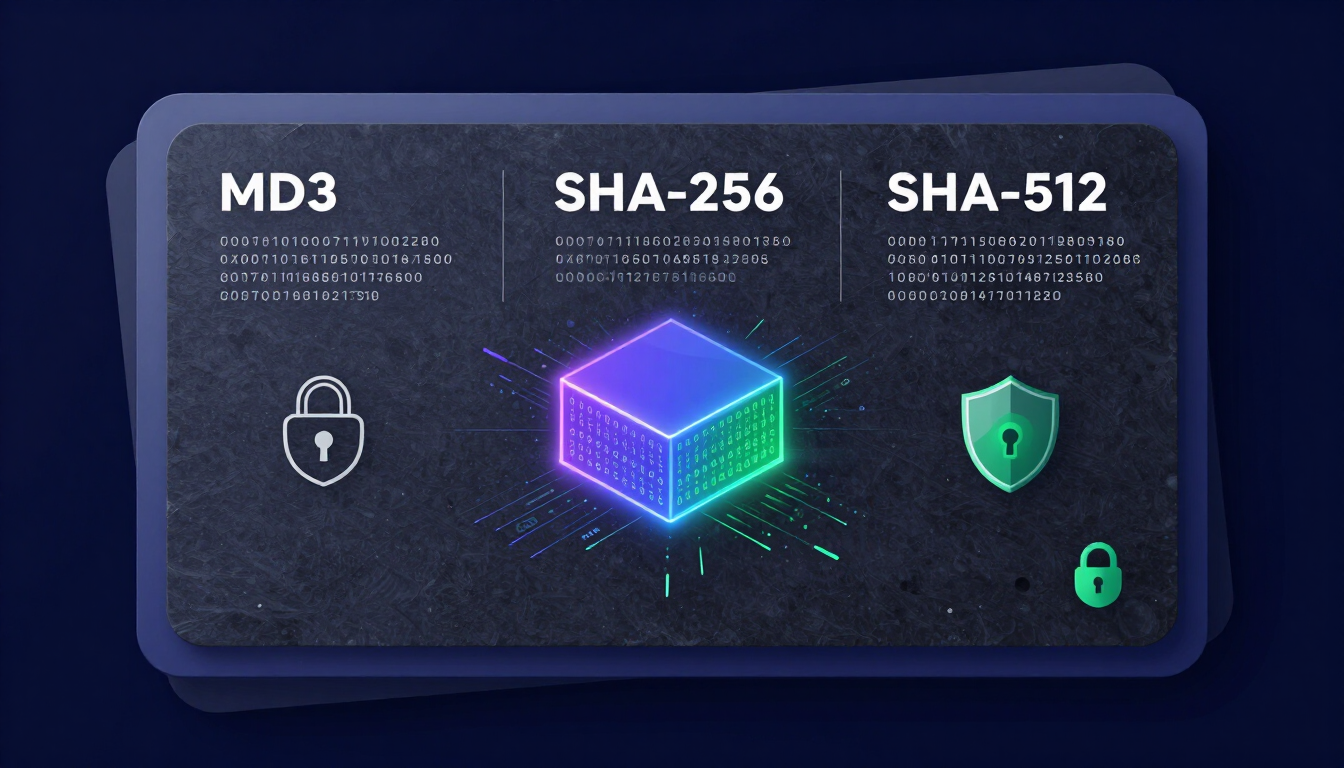
What Is the Difference Between MD5, SHA-256, and SHA-512?
The short answer, for scanners:
- MD5: Use only for quick file checksums to verify non-malicious data corruption.
- SHA-256 or SHA-512: Always use these for password storage, data integrity, and digital signatures.
- SHA-256: The current industry standard.
- SHA-512: Offers higher security and faster processing on modern 64-bit computer systems.
What Is a Cryptographic Hash Function?
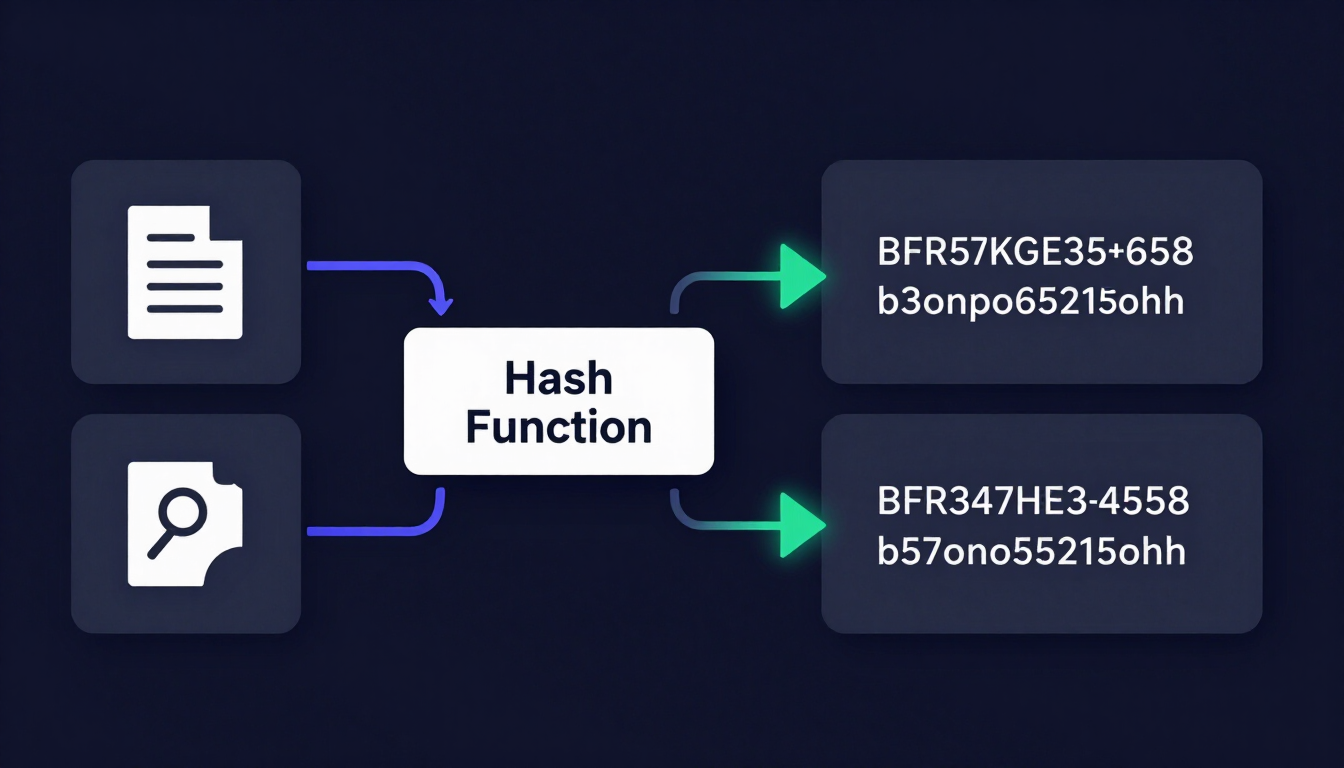
A cryptographic hash function takes any digital data — a single word, a picture, or a massive video file — and scrambles it into a fixed-length string of letters and numbers. This string is called a "hash" or "digest."
Think of a hash as a digital fingerprint. Just as no two humans share the same fingerprint, no two files should ever share the same hash.
The One-Way Street of Encryption
Hashing is not encryption. You can decrypt encrypted data if you have the right password. You cannot reverse a hash.
If you hash the word "apple," you get a specific string of characters. You cannot take that string of characters and run it backward to reveal the word "apple." This one-way street makes hashes perfect for storing sensitive data like passwords.
Key Properties of a Secure Hash
To work correctly, a hash function must do four things perfectly:
- Stay fast: It must compute the hash value quickly.
- Remain deterministic: The exact same input must always produce the exact same output.
- Hide the input: A tiny change in the input (like capitalizing one letter) must completely change the hash output.
- Prevent collisions: It must be virtually impossible for two different files to produce the same hash.
The Fall of MD5: Why It Is No Longer Secure
MD5 (Message Digest 5) ruled the internet in the 1990s and early 2000s. It outputs a quick 128-bit fingerprint. Today, cybersecurity experts consider MD5 broken for security purposes.
Why MD5 Fails at Passwords and Security
MD5 suffers from "collision vulnerabilities." A collision happens when two completely different files generate the exact same hash.
Hackers can now create two different files with the same MD5 hash in mere seconds using a standard laptop. If a hacker intercepts an MD5 hash, they can easily force a collision to bypass digital signatures or crack passwords. Do not use MD5 to protect secrets.
When to Calculate MD5 Hash Online
Despite its security flaws, MD5 remains highly useful for basic IT tasks. You should calculate MD5 hash online when you need to check for accidental file corruption.
- Downloading large files: Software distributors post MD5 hashes next to download links. You can check your downloaded file's hash against theirs. If they match, your download did not corrupt or drop packets.
- Database indexing: MD5 is incredibly fast. It works well as a unique identifier for non-sensitive database rows.
Calculate your file checksums easily — try our fast online MD5 Hash Generator tool.
SHA-256 and SHA-512: The Current Industry Standards
When MD5 fell, the National Institute of Standards and Technology (NIST) published the SHA-2 (Secure Hash Algorithm 2) family. This family includes both SHA-256 and SHA-512. They are the backbone of modern internet security.
SHA-256: The Global Standard
SHA-256 creates a 256-bit hash. It is the most widely used hashing algorithm in the world today.
- Cryptocurrency: The Bitcoin network uses SHA-256 to verify transactions and mine new blocks.
- SSL/TLS Certificates: When you see the padlock icon in your browser, SHA-256 is working behind the scenes to secure your connection.
- Password Storage: Modern databases use SHA-256 (combined with a random string called a "salt") to store user passwords safely.
SHA-512: The 64-Bit Powerhouse
SHA-512 belongs to the same family but creates a massive 512-bit hash. It is mathematically more complex and secure than SHA-256.
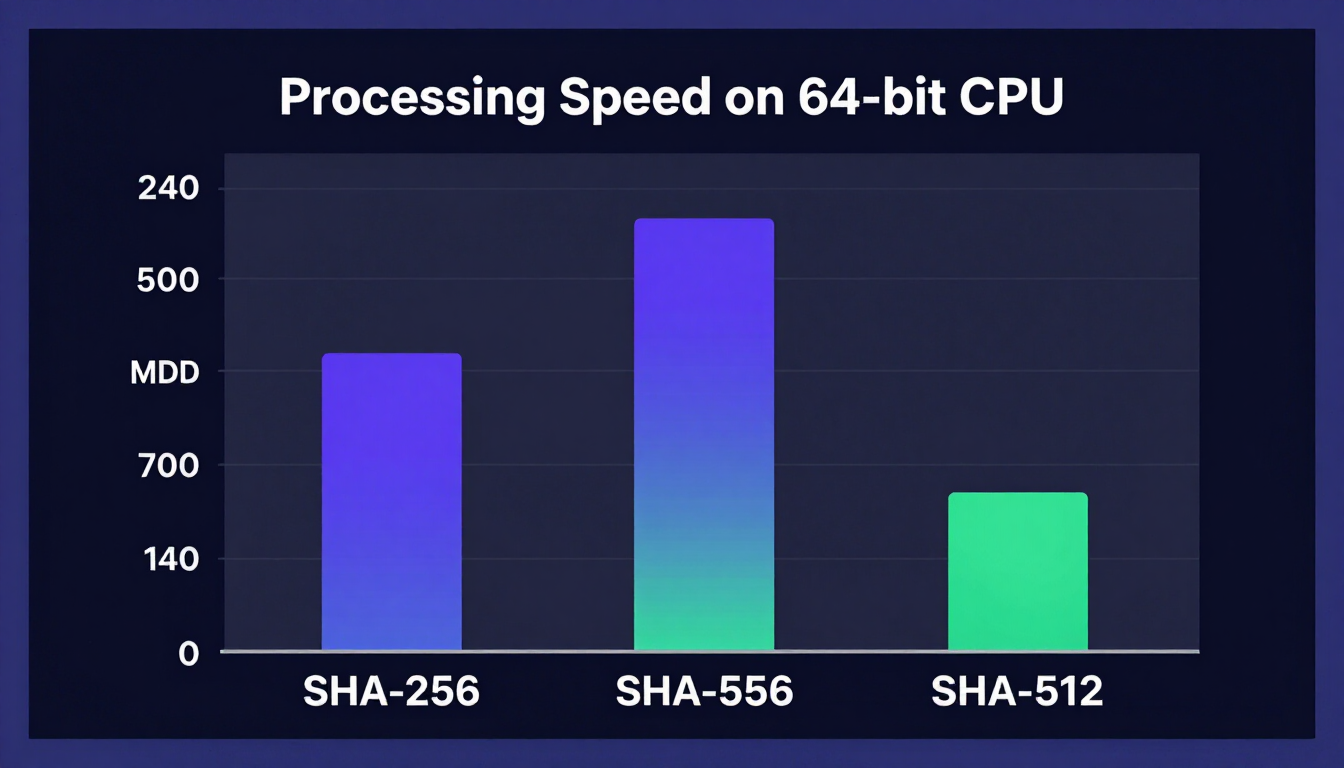
Interestingly, SHA-512 often runs faster than SHA-256 on modern computers. SHA-512 uses 64-bit words, aligning perfectly with modern 64-bit processors. SHA-256 uses 32-bit words. If your server runs a 64-bit architecture, SHA-512 offers a rare win-win: better security and faster performance.
Speed vs. Security: SHA-512 vs SHA-256 vs MD5
How do these algorithms compare side-by-side? Review the data below to choose the right tool for your project.
| Feature | MD5 | SHA-256 | SHA-512 |
|---|---|---|---|
| Hash Length | 128-bit | 256-bit | 512-bit |
| Security Level | Broken (Do not use) | Very High | Extremely High |
| Speed (32-bit CPU) | Extremely Fast | Fast | Slow |
| Speed (64-bit CPU) | Extremely Fast | Fast | Very Fast |
| Best Use Case | File integrity checks | SSL, Blockchain, Passwords | High-security data, 64-bit systems |
Why "Cute", "Funny", and "Aesthetic" Passwords Fail Hash Cracking
Many users try to make passwords memorable by focusing on aesthetics or humor. You might search for "cute aesthetic passwords" or "funny password ideas" and choose something like pinkclouds123 or letmeINplease!.
Even if a website uses a strong SHA-256 hash generator to protect these passwords, they remain vulnerable. Here is why:
1. Dictionary Attacks Destroy Funny Passwords
Hackers do not guess passwords one by one. They use software that hashes millions of common words, jokes, and pop-culture references per second. If your funny password is an existing joke or phrase, the hacker's pre-computed hash list (called a rainbow table) will match it instantly.
2. Aesthetic Passwords Lack Entropy
Aesthetic passwords rely on visually pleasing, predictable patterns (like starlight or moonbeam). Security requires entropy — true randomness. A computer easily cracks a pattern.
3. The Solution: Passphrases + Strong Hashing
To survive a modern hash-cracking rig, you need length. Instead of a cute word, use a four-word random phrase. Coffee-Stapler-Mountain-Vinyl generates a SHA-256 hash that would take current supercomputers billions of years to crack.
Need a strong, memorable passphrase? Generate a Secure Password Here.
How to Calculate Hashes Locally and Securely
You often need to verify a file or generate a hash for a specific text string. Using a web-based SHA-256 hash generator is the fastest method.
However, security matters when using online tools. Never paste plain-text passwords into an unverified third-party website.
Our internal tools run locally in your browser using JavaScript. The data never leaves your device, ensuring complete privacy.
Steps to use a web-based hash generator safely:
- Open the hash generator tool.
- Disconnect your internet (optional, but guarantees data stays local).
- Type your text or drag-and-drop your file into the tool.
- Copy the resulting SHA-256 or SHA-512 hash.
- Reconnect to the internet.
Frequently Asked Questions
Can MD5 hashes be decrypted?
No. Cryptographic hashes are one-way functions. You cannot decrypt them. However, hackers can "crack" MD5 hashes using brute force or rainbow tables because the algorithm is fast and outdated. They guess the input until the output matches your hash.
Is SHA-256 completely unhackable?
Nothing is completely unhackable, but SHA-256 is practically unbreakable with current technology. There are no known collisions for SHA-256. A standard computer would take longer than the age of the universe to brute-force a strong, salted SHA-256 hash.
Why is SHA-512 faster than SHA-256 on my computer?
SHA-512 processes data in 64-bit chunks. Modern desktop and server processors operate on 64-bit architectures. This allows the CPU to process SHA-512 commands natively and highly efficiently, often outpacing the 32-bit chunk processing of SHA-256.
Should I use MD5 for my website's user passwords?
Absolutely not. MD5 is severely compromised. Hackers can crack MD5 password hashes in milliseconds. You must use modern algorithms like bcrypt, Argon2, or PBKDF2, which utilize SHA-256 or SHA-512 under the hood but add necessary slowness to deter attackers.
What is a hash salt, and why do I need it?
A salt is a random string of characters added to a password before it goes through the hash function. It ensures that two users with the exact same password will have completely different hashes. This prevents hackers from using pre-calculated lists (rainbow tables) to crack multiple accounts at once.
Can I use a SHA-256 hash generator for large 10GB video files?
Yes. A hash function can process data of almost any size. The resulting hash will still be exactly 256 bits (64 characters long). Generating a hash for a 10GB file will take longer than hashing a text document, as the computer must read every byte of the file.
If SHA-512 is better, why do people still use SHA-256?
SHA-256 requires less bandwidth and storage space. It produces a 64-character string, while SHA-512 produces a 128-character string. For systems that process millions of transactions per second (like Bitcoin), that extra data footprint adds up quickly. SHA-256 is secure enough that the extra storage cost of SHA-512 isn't always justified.
What happens when quantum computers arrive? Will SHA-256 break?
Quantum computers will weaken current hashing algorithms, but they will not destroy them instantly. Experts believe SHA-256 will survive early quantum computing attacks. However, upgrading to larger bit-sizes, like SHA-512 or SHA-3, provides a stronger safety buffer against future quantum threats.
How can I calculate an MD5 hash without using an online website?
You can calculate hashes directly on your computer using built-in terminal commands. On Windows, open PowerShell and type Get-FileHash filename.txt -Algorithm MD5. On macOS or Linux, open the terminal and type md5 filename.txt.
Resources & Tools
Home Page
- Password Generator — https://createpassword.in/
Tutorials
- Security Documentation — https://createpassword.in/tutorials
Password Tools
- Password Generator — https://createpassword.in/create-password
- Password Generator — https://createpassword.in/tools/password-generator
- Password & Security Tools — https://createpassword.in/tools
- Passphrase Generator — https://createpassword.in/tools/passphrase-generator
Articles That Will Help You to Understand to Make Strong Passwords to Secure for Your Online Accounts
- The Ultimate Guide to Using a Password Generator Free — https://createpassword.in/blog/password-generator-free
- Passphrase vs Password — https://createpassword.in/blog/passphrase-vs-password
- Complete Guide to Creating Strong Password — https://createpassword.in/blog/complete-guide-strong-passwords-2026
- Passphrase vs Password: Which Is Better for Security — https://createpassword.in/blog/passphrase-vs-password-security
- 12 Character Password Generator: Free, Secure & Instant Tool — https://createpassword.in/blog/secure-12-character-password-generator
Leave a comment
Comments are moderated before appearing. Please keep it respectful and on-topic. Your email is required for verification but is never displayed publicly or shared.